Case study — Local SEO + quote funnel
Turning a hard-to-recover Google listing into high-intent shed quote demand
A local shed builder needed more than rankings. The campaign started by solving a difficult Google Business Profile access problem, then connected local search visibility to a quote funnel that captured real project demand.
- Client
- Shed 210
- Location
- San Antonio, Texas
- Scope
- Local SEO • Google Business Profile recovery • Quote funnel
- Live site
- shed210.com
Average quoted project value per qualified lead
Conservative quoted pipeline
The cleaned numbers
Every metric below is deduped, lead-level, and defensible.
No raw form-fill counts. Each buyer opportunity is counted once, at its highest quoted value.
Qualified quote opportunities
Deduped buyer opportunities after removing test and internal rows.
Conservative quoted pipeline
Each opportunity counted once, at its highest quoted value.
Average quoted project value
Lead-level average across qualified quote opportunities.
Unique project configurations
Distinct projects buyers configured while comparing options.
Total configured quote value
All unique configurations explored — demand depth, not revenue.
Service-area ZIP codes represented
Breadth of local demand across the service area.
The challenge
Before anything could be measured, the Google listing had to be recovered.
The business had a real local product, a defined service area, and buyers searching nearby. But the local search foundation was not simple. Before the campaign could be measured properly, the real Google Business Profile had to be recovered and brought into the same system as the website and quote flow.
That mattered because a local shed buyer does not behave like a low-ticket ecommerce visitor. They compare structure types, sizes, roof styles, wall heights, delivery areas, and add-ons before they are ready to talk. A basic contact form would have hidden most of that intent.
The goal was not just to increase visibility. The goal was to turn local visibility into quote requests with enough detail to show what buyers wanted and what those projects were worth.
Step 1
Listing hard to recover
The real Google Business Profile was difficult to access, so local visibility, trust signals, and attribution could not be controlled.
Step 2
Access recovered
The profile was brought back under the business's control and treated as a core local-search asset.
Step 3
Connected to the quote funnel
Listing, website, and quote flow were brought into one measurable system.
The campaign started with a hard local-search problem: recovering control of the real Google listing. Once that foundation was fixed, the quote funnel turned visibility into measurable pipeline.
What we built
Three connected pieces, one measurable system.
01
Local search control
The first step was getting the business back to a usable local-search foundation. That meant treating the Google Business Profile as a core asset, not an afterthought.
02
Buyer-intent SEO
Instead of optimizing only for traffic, the campaign focused on searches tied to real shed-buying intent: local availability, structure types, sizes, customization options, and service-area demand.
03
Quote funnel tracking
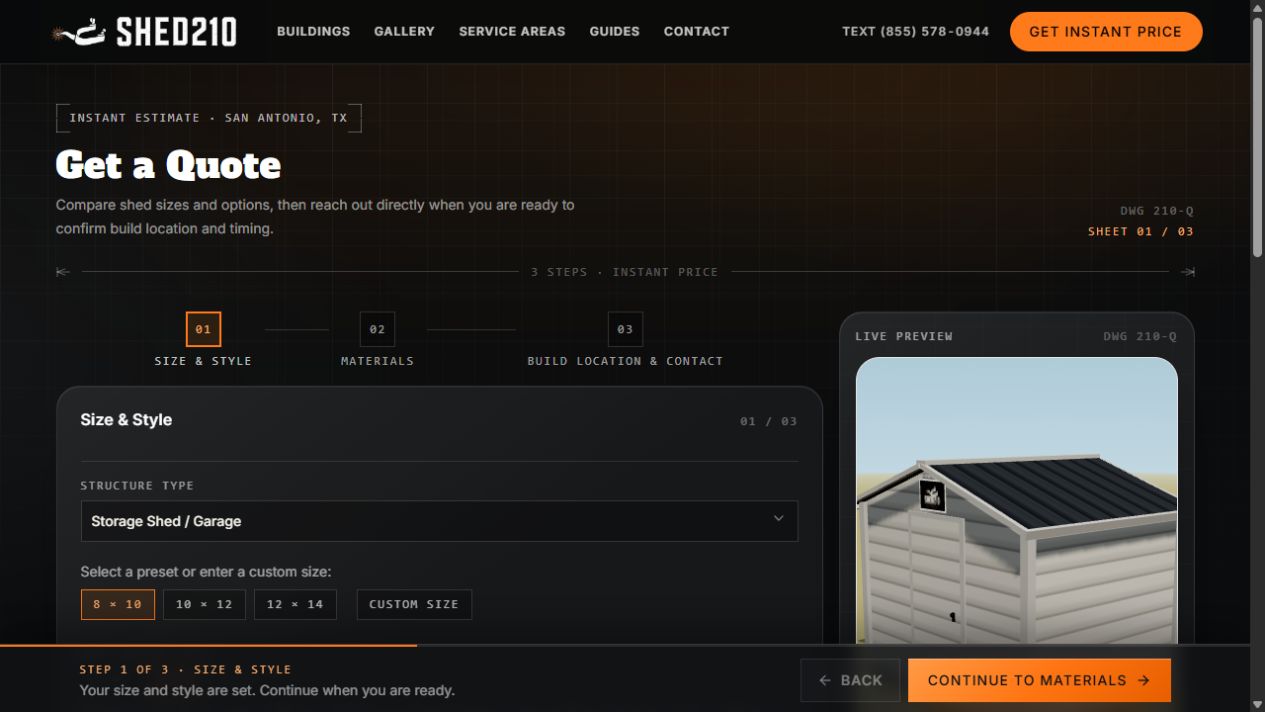
Visitors could configure sheds and related structures, then submit quote requests with project-specific details. Each request captured more than a name and phone number — it captured the buyer's size, roof style, wall height, ZIP code when available, add-ons, and quoted project value.

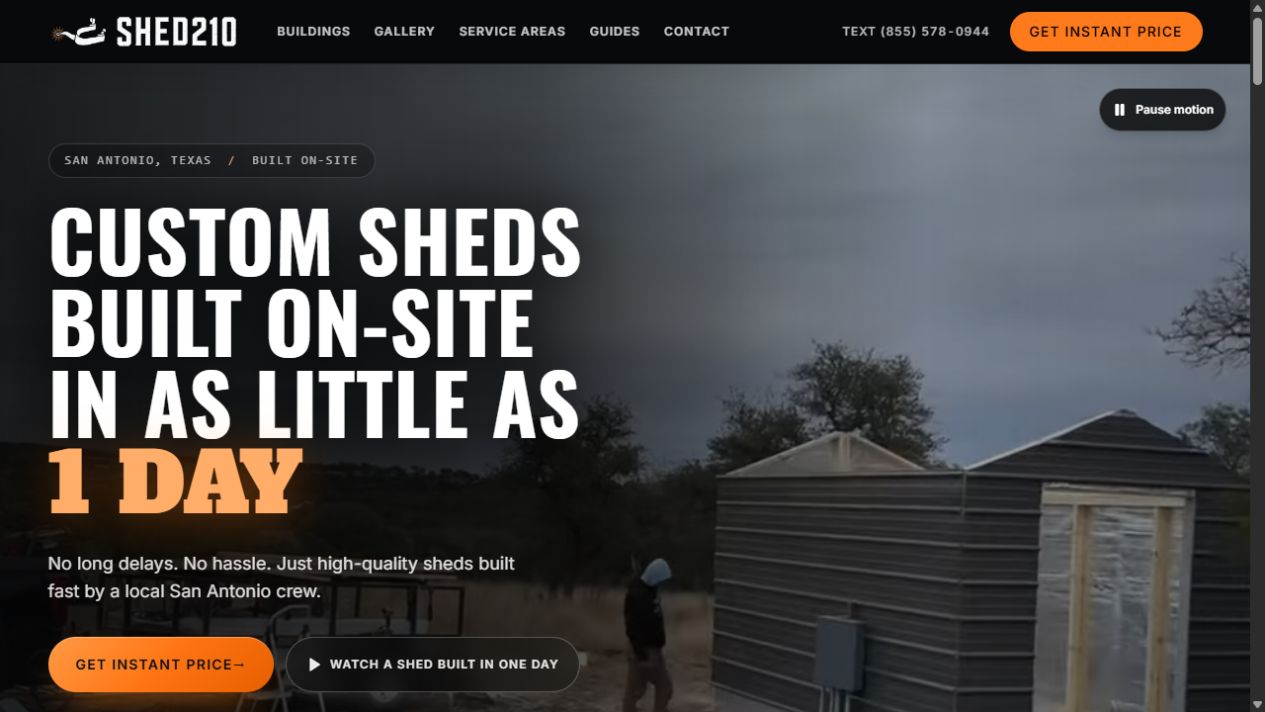
Conversion-first homepage
Local availability, structure types, and quote paths above the fold.

3D shed configurator
Buyers assemble size, roof style, wall height, and add-ons in the browser.
Lead flow
From a nearby search to a spec-complete quote in one motion.
Every step feeds the next, and every quote request lands with the project details already attached.
- 1
Local search
Buyer-intent searches for sheds, sizes, and availability nearby.
- 2
Google listing
A recovered, fully controlled Google Business Profile.
- 3
Website
Landing pages matched to what local buyers actually search.
- 4
3D configurator
Buyers configure structure, size, roof style, and add-ons.
- 5
Quote request
Each submission carries project specs and quoted value.
- 6
Instant follow-up
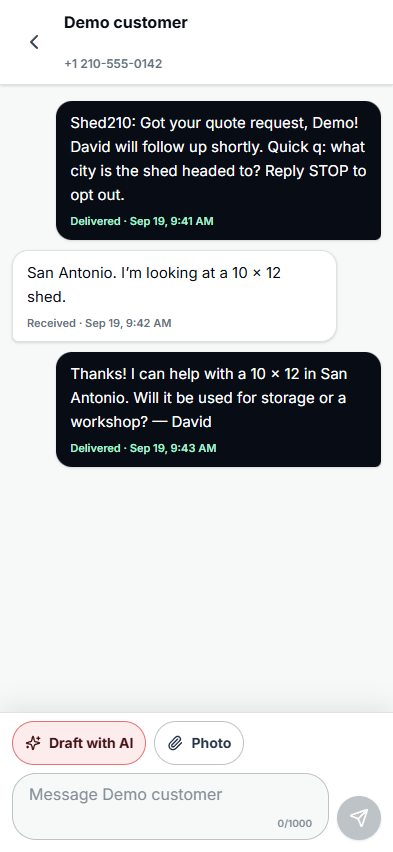
Owner is alerted by text the moment a quote lands.

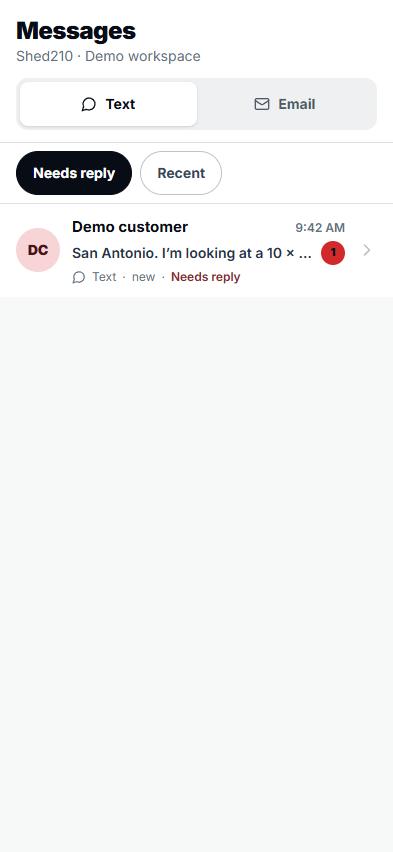
Instant owner alert
Every quote request lands as a text with full project specs.
The cleaned results
Conservative pipeline, not inflated totals.
After removing obvious test and internal rows and deduping repeat submissions, the dataset showed 40 qualified quote opportunities, $196,042 in conservative quoted pipeline, a $4,901 average quoted project value per qualified lead, 94 unique project configurations, $427,419 in total configured quote value, and 30 valid service-area ZIP codes.
The conservative pipeline number counts each buyer opportunity once, using the highest quote tied to that opportunity. The larger configured value captures all unique configurations buyers explored, which is useful for understanding demand depth but should not be presented as revenue.
The deeper insight
The strongest result was the quality of the buying behavior.
The funnel did more than capture leads — it revealed what local buyers wanted, compared, and were willing to spend.
Buyers were actively comparing options
35% of cleaned quote opportunities explored more than one configuration. Those multi-configuration leads carried a meaningfully higher top quote — the funnel was capturing shoppers weighing different project scopes, not just people filling out a form.
Average top quote by shopping behavior
$6,038
Leads that explored multiple configurations
$4,289
Single-configuration leads
The quote funnel revealed product demand
Storage sheds accounted for 87% of unique configurations and 86% of configured quote value, making them the clear core offer. But the funnel also captured related demand for portable garages, greenhouses, and well pump covers — future content and sales angles the business now knows about.
Configured quote value by product
Volume sizes and value sizes were different
The most common configuration was the 8x12 — 35 configurations and more than $107K in configured quote value. But the strongest value drivers were larger builds: 10x16 and 12x20 together represented more than $176K in configured value. That split tells the business where volume lives and where the high-ticket projects come from.
Configured quote value by shed size
Add-ons were a major buying signal
46% of unique configurations included add-ons or upgrades, and 50% of quote opportunities included at least one. Configurations with add-ons averaged $5,008 against $4,158 without — customization interest is real value on the table.
Average configuration value
$5,008
With add-ons or upgrades
$4,158
Without add-ons
Add-on frequency across unique configurations
- Ground anchoring14
- Electrical prep13
- Roof overhang12
- Insulation12
- Skirting9
- Ramp (double door)8
- A/C knock out8
- Workbench7
- Ramp (single door)6
- 2-tone finish5
- Loft4
- Steps3
Premium projects, not just small inquiries
Nearly half of cleaned opportunities had a top quoted value of $5,000 or more, and almost a quarter reached $7,000 or more. The campaign attracted buyers considering meaningful projects — across 30 service-area ZIP codes.
Why this matters
A bridge between local search visibility and sales intelligence.
Most SEO case studies stop at rankings, traffic, or form-fill counts. That would have missed the real story here.
This campaign created a bridge between local search visibility and sales intelligence. The business could see which structures people wanted, which sizes were most common, which add-ons appeared repeatedly, which ZIP codes were represented, and how much qualified quote demand was being created.
That is the difference between “SEO generated leads” and “SEO produced measurable local buying intent.”
The most valuable insight was not just that people requested quotes. It was that buyers were configuring real projects, comparing upgrades, and revealing what they were willing to spend.
Work with us
Want local SEO that can be measured by quoted pipeline instead of rankings alone?
Let's build the local-search foundation, tracking, and quote funnel that shows what your buyers are actually looking for.